A shawl is flexible; a letter is fixed. The visual task is to connect them without losing the link to the name or reducing the shawl to a passing illustration.
HIART / Trend Shawls / DESIGN STUDY
A shawl takes flight.
A name moves with it.
We begin with something tangible: the lifted edge of a shawl. Within it, ت and T meet an upward movement that gives Trend a visual meaning.
Step inside the idea ↓IDEA → STRUCTURE → EXPERIENCESCROLL · DISCOVER · INTERACT
THE IDEA BEFORE THE IMAGE
What does a name look like
when its product moves?
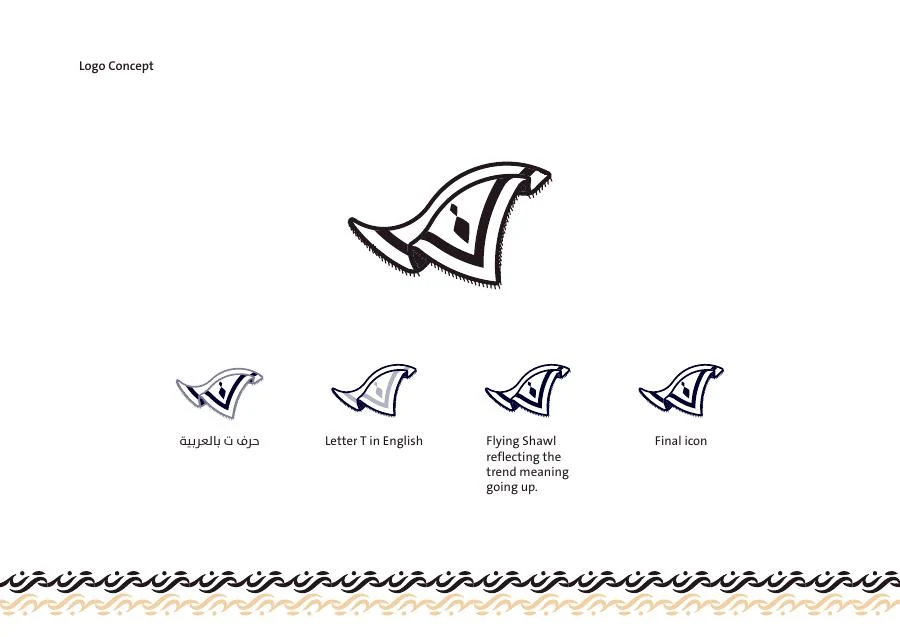
The concept board combines the Arabic initial, the Latin initial and a flying shawl in the same symbol. Its source explanation explicitly connects the rising movement to the idea of an upward trend.
02 / WHERE DID THE FORM COME FROM?
Look closer.
Every part has a role.
Choose a part to read its role in the composition. Each detail comes directly from the original concept board.
01 / 04
ت · the Arabic name
The connection begins with the name. ت can be read within the mark, keeping a linguistic entry point even as the form borrows movement from fabric.
02 / 04
T · the Latin echo
T is not a second mark, but another reading of the same composition. The relationship lets the name appear in two languages without splitting its character.
03 / 04
The shawl · material in motion
One edge rises while another follows a curve. The product becomes a gesture, carrying the meaning of the name upwards.
04 / 04
The mark · the readings meet
The three readings settle into one form. Recognising the shawl is the first encounter; discovering the letters rewards a closer look.
View the complete concept board ↗
03 / WHEN THE CONTEXT CHANGES
How does movement live on
when the logo stands still?
Design is a set of relationships. What changes between these readings, and what keeps the character intact?
01 / 02
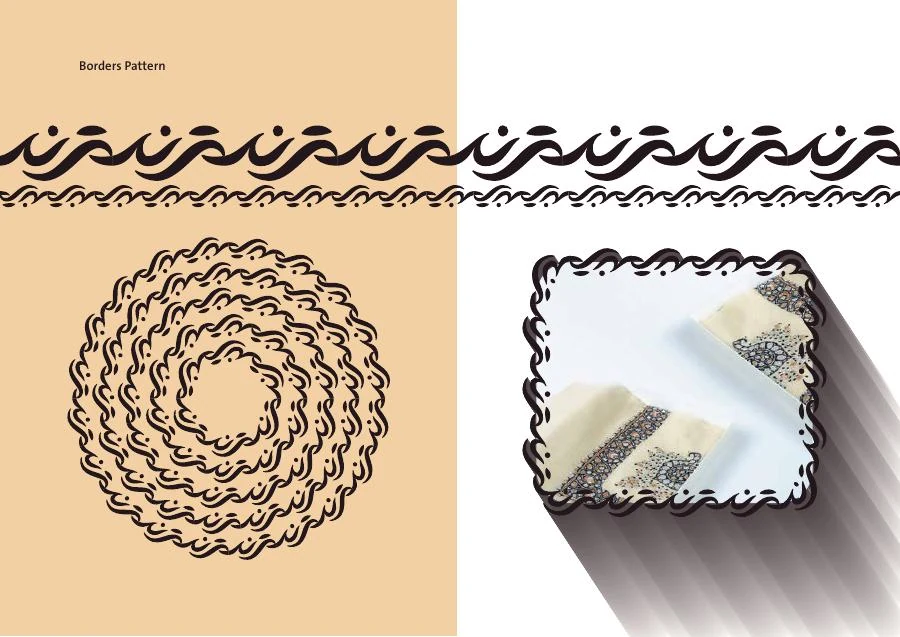
A continuous border
The pattern stretches the movement into a long line, like a fabric hem. Repetition gives direction around the surface without occupying its centre.
02 / 02
A circular border
When the rhythm turns, it becomes a circular frame. No new symbol is needed: rearranging the same units changes the relationship to space.
04 / PUT THE IDEA IN YOUR HANDS
Move the hem.
Follow the rhythm.
Drag to move a magnified section of the original border. The movement explains the pattern’s continuity; it does not alter the identity design.

05 / BEYOND THE MARK
The surface changes.
The connection stays.
SCENE 01 / 03
From fabric to paper
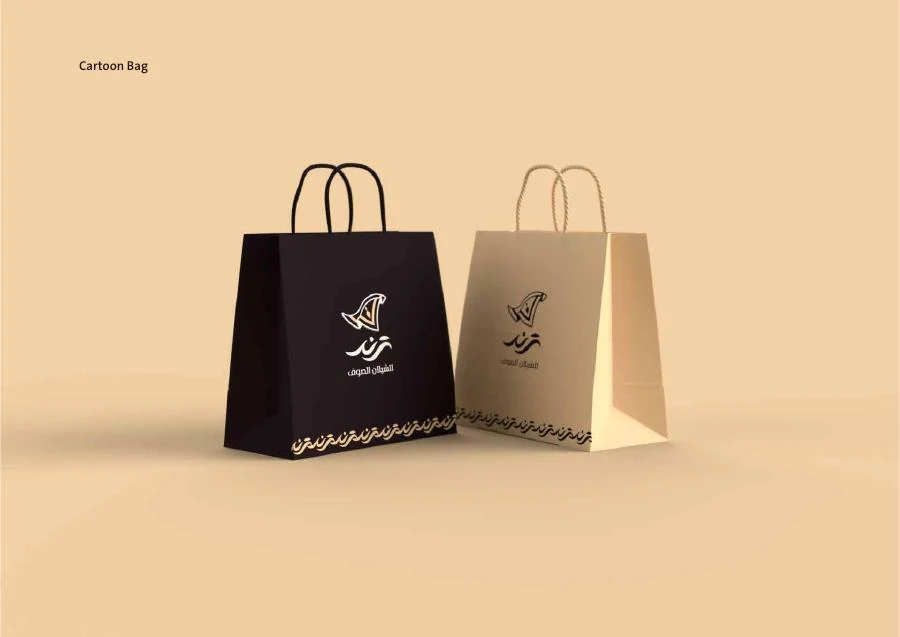
The paper bag reserves its centre for the name while the border ties the sides together. Dark and light versions exchange the roles of ground and mark.
SCENE 02 / 03
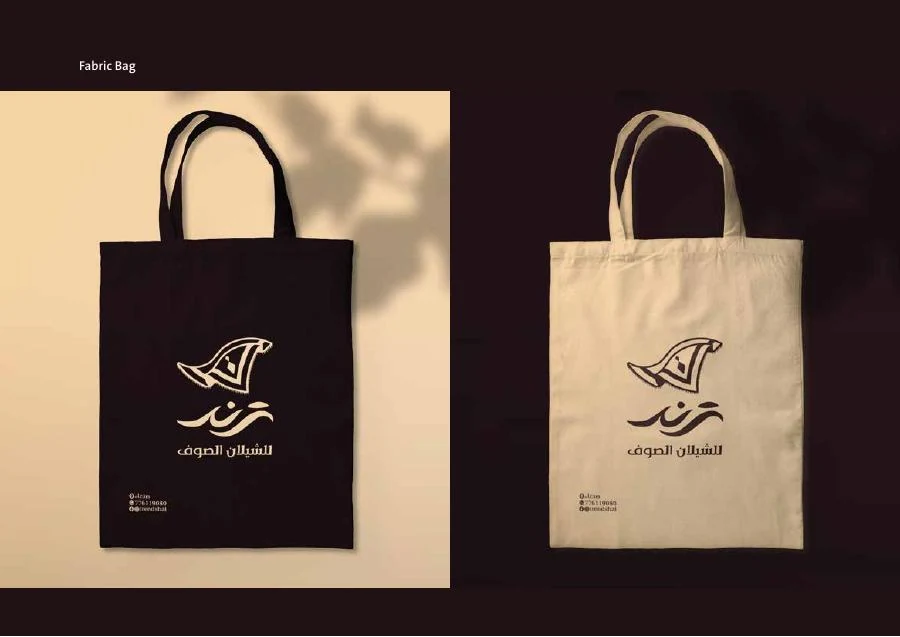
The product remembers its material
The fabric carrier returns the identity to a material close to its world. The texture changes while the link between mark and movement remains.
SCENE 03 / 03
An ending that opens a story
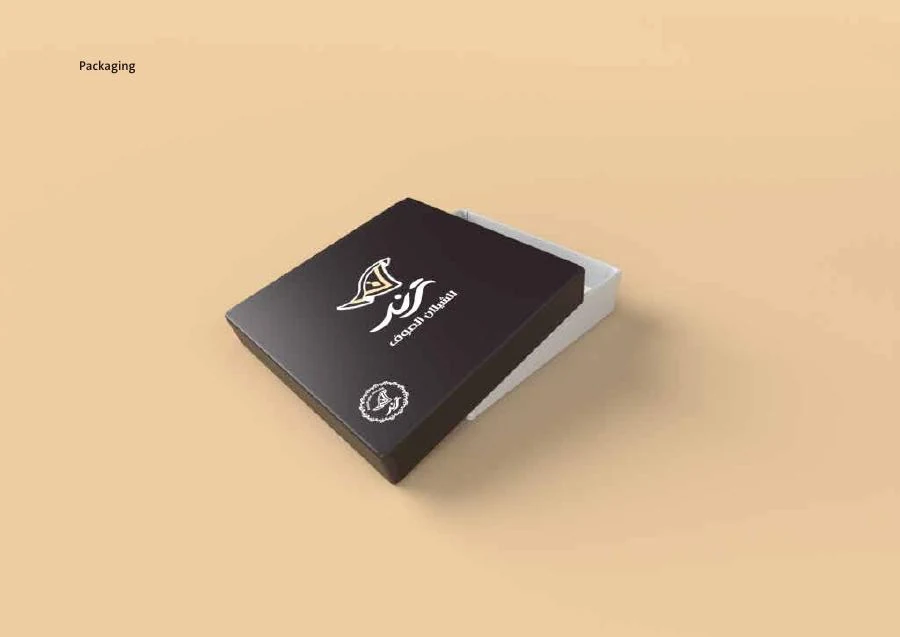
On the box the shawl stands still, yet movement remains in its angle and curves. A quiet moment after all that rhythm.
WHAT MAKES IT AN IDENTITY?
When an identity comes from the product’s movement, the idea can outlive the logo: becoming a border, a circle, a texture and a way to present what is inside.
Sources and context · open the project boards
The initials, shawl and upward movement are documented in the concept board. The rest is a visual reading of the original pattern and applications, without assumed approval reasons or commercial results.